When “Win‑Win” Means Losing
Trade secrets, shell companies, and capital are rewriting who controls western companies and brands.

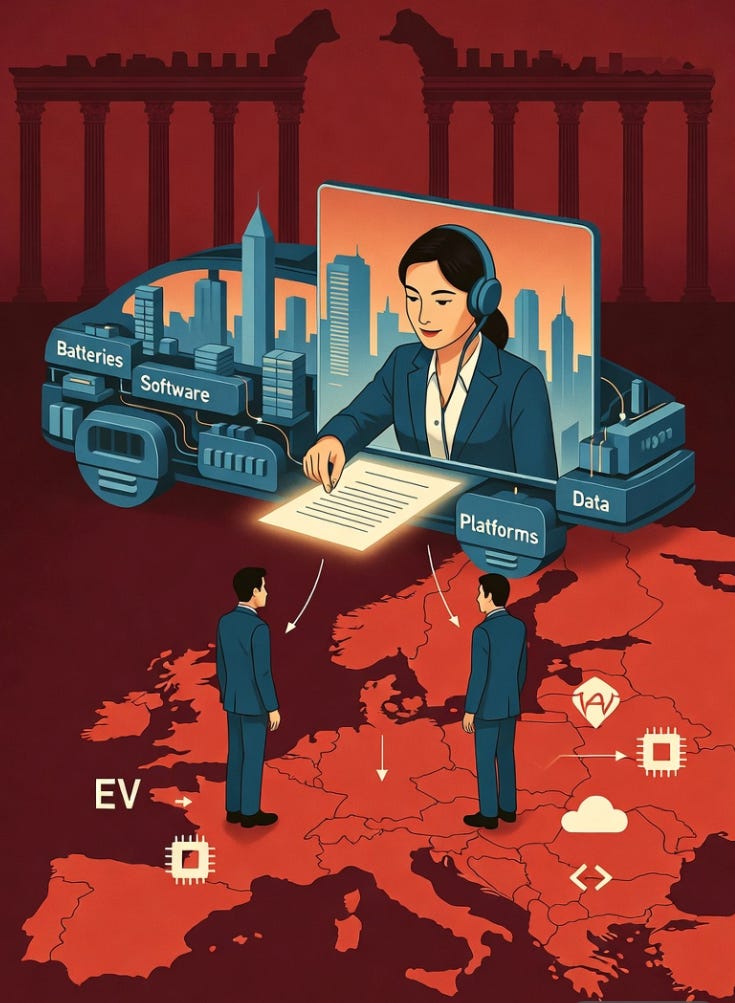
“A great civilization is not conquered from without until it has destroyed itself from within.
Great industries are rarely beaten from the outside.
They rot first from within,
when they start trading knowledge for profit and convenience.”
Not long ago, I was on a video call with a venture capitalist. Call her Karen—sharp, unsentimental, and plugged into a network that runs from Beijing co‑working spaces to Sand Hill Road. It was only our second conversation, but she was already sketching out her plan. “We’ll set up a new European company,” she said, as casually as if she were ordering coffee. “You can be the faces—the public leaders. But it belongs 100% to us.”
Patents? Not something she lost sleep over. She had lawyers who knew how to dance around them, and if regulators ever made things uncomfortable, the core business would stay tucked safely inside China’s borders. Electric vehicles? She brushed them off with a wave. “I don’t care about EVs. I just want to make money.” It sounded like someone who had sat through too many partner meetings at the right Plug‑and‑Play‑style outfits, the ones where deals move faster than due diligence. Her firm’s website was bland as unsalted rice—generic talk about innovation and global impact. Behind that, no one could sense a much bigger machine.
This is a real conversation and shows how China’s appetite for intellectual property eats through legal and geographic boundaries. These tactics aren’t fringe. They form a recognizable playbook: front companies, opaque cap tables and backends, “localization” that looks suspiciously like replication. If Western firms don’t adjust, they will wake up to find themselves reduced to annotations in someone else’s success story.
Geely, the Chinese automaker, bought Volvo in 2010 for about 1.8 billion dollars. On paper, it looked like globalization: a rising Hangzhou‑based group rescuing a Swedish icon from Ford in the aftermath of the financial crisis. They promised to preserve Volvo’s independence and develop a new generation of models. Today, Volvo is widely seen as revitalized under Geely’s umbrella, with cars like the XC90 that blends Scandinavian design with Chinese manufacturing and capital. But in the background, the IP stakes have only grown sharper. In a landmark trade‑secrets case, Geely accused rival startup WM Motor of stealing highly sensitive chassis and component designs.
In 2024, China’s Supreme People’s Court ordered WM Motor and related parties to pay around 640 million RMB—roughly 90 million dollars—in damages. A record amount for that kind of case. The judgment showed how quickly crucial know‑how can migrate inside China’s auto ecosystem—sometimes through formal partnerships, sometimes through engineers who leave with more than institutional memory.
This pattern isn’t new. In the 2000s, General Motors engineer Shanshan Du in Detroit was caught copying tens of thousands of files on GM’s hybrid propulsion systems. A U.S. court later concluded that she and her husband intended to parlay that trove into a business selling hybrid expertise to Chinese automakers, including Chery. The FBI sting ended with convictions and prison terms, and Chery publicly denied benefiting from stolen technology. Hard proof that specific models like the QQ were built directly on Du’s files never surfaced. What emerged over time was a new path: Chery’s evolution from budget minicar maker to one of China’s most aggressive exporters that ships hundreds of thousands of vehicles abroad each year. This again mirrors a broader reality of Chinese companies absorbing know‑how wherever they can and then scaling it hard.
The scale of the game is mind-blowing. U.S. commissions and trade bodies have estimated that intellectual‑property theft across all sectors costs the American economy hundreds of billions of dollars annually. Autos and advanced tech or manufacturing sit directly in the blast radius. By the mid‑2020s, Chinese carmakers had turned into export powerhouses, with overall vehicle shipments in the millions. Brands like Chery meanwhile push record volumes to Asia, Latin America, the Middle East and, increasingly, Europe. They used aggressive pricing and quick technology iteration to claw into markets where Western firms, like Bosch or Continental, once felt out of reach.
Why does this keep happening? Because China’s system doesn’t just tolerate it—it often rewards it. Karen’s offer—set up a “European” shell, keep the real control and IP in Chinese hands—captures what has become almost commonplace in both Europe and the States. From the “Go Out” strategy of the late 1990s onward, Chinese policy has openly encouraged firms to acquire technology, brands, and resources overseas. At its peak Chinese outbound investment into Europe ran into the tens of billions of dollars a year. In automotive, that translated into deals like SAIC’s control of the MG brand, which gave a state‑backed Chinese group not just a beloved British badge but a design and engineering base it could intertwine with its own at home.
By the mid‑2020s, MG‑branded EVs such as the MG4 were selling in serious volumes across Europe, often thousands of euros cheaper than comparable European models like Volkswagen’s ID.3 while still offering competitive range and tech. The debate is no longer whether Chinese firms gain from the IP and experience they pick up through acquisitions and joint ventures—they plainly do—but how well Western boards and regulators understand the long‑term implications.
A wave of work on Chinese outbound investment points out, that a significant share of deals target tech‑intensive assets. Owners often route investments through complex chains and nominee directors, which makes it hard to decode effective control, especially at first glance.
Karen’s indifference to patents fits perfectly into this picture. Chinese engineers, law firms, and corporate strategists have become very skillful at operating in the gray: filing tight design‑around patents that pass local examiners while capturing the functional essence of foreign designs. China’s share of global EV‑related patent filings has surged from the low single digits around 2010 to something on the order of a quarter or more by 2020 and beyond. Depending on how the field is defined, Chinese entities are now responsible for a leading share of such filings in many recent quarters.
Western automakers that once assumed a comfortable lead now face Chinese rivals holding thick patent blocks around batteries, power electronics, and control software—some the fruit of genuine research breakthroughs, some the product of relentless incrementalism built on earlier collaborations.
Cross‑border accelerator programs, Plug‑and‑Play‑style platforms and even automotive TurnKey-Solution Services show what China is capable of. The West marketplace is just used as a neutral bridge between startups, corporates, and capital. In practice, the money often traces back, at least in part, to funds and conglomerates that sit within Beijing’s industrial‑policy orbit. At the same time, research on Party‑state governance has tracked how Communist Party committees have spread inside ostensibly private companies, including in advanced manufacturing, giving the Party a seat in strategic decisions and aligning corporate priorities with national goals.
In automotive, that means steering capital, subsidies, and talent toward electric vehicles, batteries, and software platforms identified as “strategic,” even when individual executives present themselves as purely commercial actors.
This is, btw no secret. China’s industrial playbook is not hidden in footnotes; it is spelled out in official programs like “Made in China 2025,” which pushed new‑energy vehicles, advanced batteries, and next‑generation IT to become core pillars and speak explicitly about achieving global leadership rather than low‑margin contract work. Battery companies like CATL and BYD now control large portions of the global supply chain. When a European‑branded SUV rolls out of a factory with a Chinese LFP pack inside, or debuts on a platform co‑developed with a Chinese partner, the technology flow no longer runs predominantly from West to East; it is increasingly bidirectional—and often even highly asymmetric. It’s transforming from “Designed in the USA or Europe and manufactured in China”, to, “Designed and manufactured in China for a Western Brand”.
No company embodies the first approach more clearly than BYD.
It began life in the 1990s as a scrappy battery manufacturer and spent years perfecting lithium‑ion production before pivoting into autos, ultimately becoming an EV giant that sells millions of vehicles annually. Along the way, it acquired step-by-step assets, talent, tacit knowledge, and slowly moved up from contract manufacturing and licensed technology to homegrown innovations like the Blade battery. A long‑life LFP architecture that now anchors a growing share of its lineup.
Today, BYD is building out a European footprint, with a major plant under construction in Szeged, Hungary, and even a European headquarters including a R&D base in Budapest. So that “Made in China” technology can officially roll off as “Made in EU” from its assembly lines. Smart. That brings jobs and investment, but it also deepens Europe’s dependence on Chinese platforms, standards, and suppliers.
All this eats away at the West’s edge.
Chinese EVs routinely land in European showrooms thousands of euros below their local rivals, benefiting from state support at home and hyper‑efficient supply chains that Europeans struggle to replicate. Volkswagen, Mercedes‑Benz and others have watched Chinese brands chip away at their share in segments they once dominated. Even as they remain bound in joint ventures and supply deals inside China that make clean disentanglement extremely costly.
Each new “win‑win” arrangement looks a little less balanced and a little more like a quiet transfer: software insights, manufacturing refinements, and user‑data feedback loops that enrich the Chinese side while Western partners get thinner margins.
But there are signs of resistance.
In 2024, the European Union moved to impose additional tariffs of up to about 38 percent on Chinese‑made EV’s—on top of the existing 10 percent. Behind the legal language was a broader worry about over‑reliance and a sense that European firms were competing not just with companies but with a state‑backed system. Policymakers and some corporate leaders have tightened the rules on what technology can be shared. Officially sensitive R&D is done, and how much access Chinese partners have to core software and data, even as many existing joint ventures and supplier relationships grind on.
What remains missing in many Western responses is not information but ruthlessness. Boards still chase short‑term gains—cheap assembly, fast China growth—because the slow erosion of distinctive know‑how barely registers on quarterly dashboards. European think tanks like now argue for a smarter line. Like, welcome capital and jobs where they make sense, but bake in reciprocal IP protection, rigorous screening of tech‑heavy investments, and bright red lines around data and algorithms.
They structure partnerships so that the European side keeps “control” over the (what they think the) crown jewels (are)—core software, vehicle architecture, and system integration—even if the final assembly happens in low‑cost plants half a world away.
But this is still reactive, not active, and also far away from being a leader.
They say.
History doesn’t repeat, but it rhymes.
Rome did not fall solely because of external enemies; it slowly decayed from within – through excessive debt, overconfidence and elites who confused tactics with strategy and stability. Marcus Aurelius, camped along the empire’s northern frontiers, wrote about focusing only on what is within one’s control. Western automotive giants face a similar choice: treat their IP and systems as fortresses to be defended, not bargaining chips to trade away for this quarter’s earnings bump.
When Karen’s call ended, she wrapped up with a promise:
“We’ll make this work.”
I declined, politely.
She will, however, find another guy, another lab, another startup staring down a runway that suddenly looks very short. For her side, the deal will eventually work—somewhere, with someone. That’s for sure.
For Europe and the West, it only works if they stop playing.
The car business is no longer just about engines and sheet metal; it is code, batteries, data and speed. China is moving to capture all four, one front company and “strategic partnership” at a time. The only real question is not whether that campaign will succeed, but what choices you will make when it does.
That’s it for today.
If you think this might be helpful to someone you know, be a good friend and forward it to them.
Take care,
Michael
Disclaimer: All company names in this article are only for illustrative purposes. And this is no legal advice.